



Our permanent programs
Kindergarten and school activities
Preschool classes for children from 3 to 5 years old:
The aim of the Bóbita Hungarian language kindergarten classes is to introduce the Hungarian literary language and develop vocabulary in kindergarten groups. Our main goal is for the children to feel good, relax, and expand their vocabulary. We play, paint, draw with them, learn rhymes and circle games, listen to and process fairy tales together.
Preschool program for children aged 5 to 7:
In the preparatory year, we consider it important to create a transition between the playfulness of kindergarten and the more formal form of school education. Of course, we are already learning to syllabify and break words into sounds. We learn the printed form of letters and, based on this, how to pronounce them. We help with tongue twisters and playful tasks to master Hungarian pronunciation. The development of verbal expressiveness and vocabulary also plays an important role, which we also help with through dramatic games.
First class:
Our first graders master the technique of reading together, focusing on the characteristic Hungarian letters, the first spelling rules, the basics of syllable structure and hyphenation. We practice the interpretation of word structures, sentence formation, sentence segmentation, and develop emphasis and text comprehension. We do all this in a playful way, with a variety of tasks and tools that develop the children's skills and abilities, so that the activities are a joy and not an additional burden for us.
Second, third and fourth grade:
We will learn the meaning, usage, types and punctuation of sentences. We will start to create short texts. This is where the curriculum includes text cohesion and the basic units of the text. The most important task of the third grade is to educate students to become writers and readers. We will place great emphasis on developing vocabulary, silent reading speed and comprehension, as well as written text creation.
We continue the work we have started with the fourth graders, creating independent works of writing suitable for our own and each other's entertainment: we write poems, funny, instructive stories, and even dramatize them.
5-6th grade
In this group, the emphasis is on language use. We further expand vocabulary, develop reading comprehension, writing, and spelling.
We begin to get acquainted with literature - here we are no longer just reading young adult novels -, we process János Vitéz, learn the most common poetic images, simpler rhymes and rhythm. We also create poems together and use metaphors, similes and personification.
We read and analyze short stories and poems, and we get to know some important poets and writers. We present their lives with the help of gossip and anecdotes to make them memorable. Such colorful little things leave a much bigger mark on the children.
Hungarian literature, book club, for children over 11 years old:
In this activity, we read young adult novels together, which we process together through conversation, debate, dramatization, and writing various journalistic works. Our goal is for the children to learn to express their opinions, acquire the
a culture of debate and various possibilities for processing literary works.
History from 10-11 years old:
Hungary, the history of the Hungarians with tales, legends, strange, interesting customs, anecdotes. Contemporary fashion, regions, ethnic groups, characteristics of minorities, court customs, food, hunting accidents, all in an interesting, humorous form.
Board game club for ages 10 and up:
The aim of the pedagogically based session is to bring together teenagers over 10 years of age in a family-friendly, informal atmosphere, thus enabling them to break away from the virtual world from time to time, without any violence. With the help of guided self-awareness and team-building games, situational games, and board games, we will help them in socialization and in building social relationships. We will guide them on how to cooperate with each other, face their problems, manage them, and solve them. We are waiting for all young people over 10 years of age who are tired of online learning and virtual relationships, who would like to communicate with their friends in person and not via messenger or text messages. Those who would like to have a good laugh and make lifelong friendships, and who would rather say goodbye to their peers with a big hug and a smile at the end of the session instead of pressing the red or delete button 🙂.
Cooking club
Cooking is a joy
Once a month we cook and bake together with the children in the equipped kitchen of the cultural center. Each time we prepare a cooked dish or a dessert. We would like to introduce the children to Hungarian dishes and holiday specialties as much as we can. Of course, we eat what we cook, and what is left over can be tasted by the parents, or it is beautifully wrapped and sent to the family table as a gift.
Not only do we cook together, but the children also receive the recipes so they can cook/bake them at home with their parents.
On Sundays, we are once again welcoming all interested children between the ages of 8-18 to the Bóbita Cooking Club. We will welcome the children with many interesting recipes and we will eat the dishes we have cooked together. Those who have participated in the baking and cooking with us in previous years will know, and those who have not yet will be able to experience that we spend a few hours together in a great atmosphere, learn the basics of cooking, taste delicious dishes and, last but not least, live well together.
We would like children to feel and experience the joy of cooking together, learn basic kitchen tricks, get to know the world of spices, the names of different dishes, and the experience of eating together in a larger group.
Cooking is a trend these days, but not by chance, as it takes time, attention and skill to achieve an edible, tasty result. At the same time, it relaxes, entertains and develops. It develops concentration, logical sense, attention and, last but not least, aesthetic and critical sense. It also represents a challenge, as you have to taste and coordinate new flavors.
Sunday between 10 a.m. and 1 p.m.
Cost contribution which also includes the price of the lunch eaten together:
Occasionally 50 euros /person
Location: Op Weule Cultural Center, WoluVe Saint Lambert
Participation requires registration!!!
Apply by email: bobita@live.be
Summer camps
Off to camp!
Our summer camp for 12-18 year olds, launched in 2018, has proven to be very successful.
In the first year, the central theme of the camp was street graffiti, comics and art nouveau. Then photography, various forms of photography (nature, advertising, portrait, press photography) came into focus, and of course games, puzzles and competitions were also not to be missed. In addition, we got to know the city, its parks, museums, squares and interesting, exciting places. Perhaps we could also give the title to all this, which was educational even for us, to the following: interesting, exciting city walks for young people.
Our second camp, called the Knights' Camp, started in 2019. In a wonderful rural setting, among 200-year-old trees, a large villa with a garden, the center of our association, provided the setting for this camp from the first day to the last about the age of chivalry, the life of knights, and fairy-tale knights and princesses. We sewed clothes, made coats of arms, weapons, baked real sourdough bread, and fought, fought numbers wars, competed in obstacle courses, and finally, on Friday, we inaugurated knights.
We used Easytransport to transport the children to the camp from the city to Brain L'Alleud and back in the morning and afternoon.
In 2022, the theme of the camp was criminal investigation and crime journalism. Our task was to solve a crime, locate and interview witnesses, search for clues, expose the perpetrator, and continuously document our work.
We investigated various locations in Brussels.
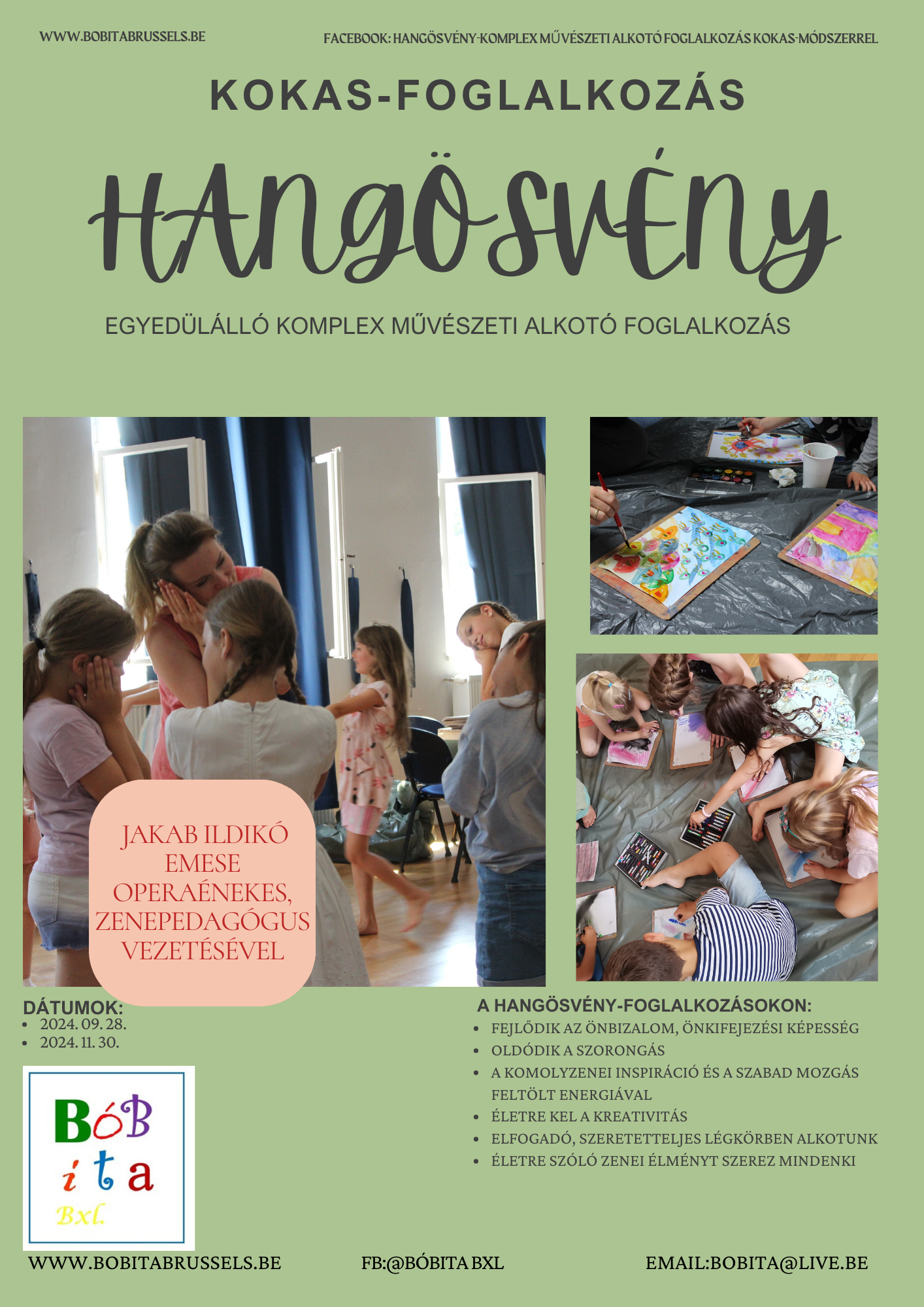
Sound Path - complex artistic creative activity with the Kokas method
Sound Path - Create WITH MUSIC/FOR MUSIC/FOR MUSIC!
Kokas class with music teacher Ildikó Emese Jakab
Children's imaginations are limitless. They can come up with a hundred different answers to even a simple question.
Each of their ideas is sincere, original and unrepeatable. But what happens when they start to unfold their creativity on the wings of music? How many textual variations can we find for a single line of a Hungarian folk song? How can we use our bodies as rhythm instruments? How many moods can be associated with a word? Can our emotions be expressed only through movements? How do our personal stories take shape in our dance? How does the paper fill with the colors of music? Does the music of Bach, Mozart and Beethoven really find its way to each of us?
"Music is spiritual food, and nothing else can replace it." (Zoltan Kodály).
At the HangÖsvény classes, opera singer and music teacher Ildikó Emese Jakab invites children aged 3-10 on a special adventure, so that they can all experience the combined joy of liberated singing, limitless musical improvisations, community creation, quality music reception and visual education by singing in their native language and playing with our folk songs. No prior musical training is required. In an accepting atmosphere, creativity comes to life, anxieties are dissolved, self-expression and self-confidence develop, and the soul is purified and grows. This is Klára Kokas' music pedagogy.
OUR PROGRAM
List of services
-
The basicsList item 1Studies show that a positive preschool program has long-term benefits for children’s development. Experts have found that children who attend high-quality preschool programs have better vocabulary, reading, writing, and math skills than other children. What’s more, children who attend preschool have better social skills and are more adaptable to change and new situations. For many children, preschool is the foundation of their education. It’s a time when they play and learn at the same time, two aspects that have many similarities. Kindergarten is an important stage for children and a big decision for parents. Remember that the quality of education you choose for your children at this stage of their development will have a big impact in the long run.
-
Rhyme-telling and musicList item 2Rhymes are also an emotional boost, a shared, joyful experience that strengthens your bond and connection. Understanding the rhythm of language is important for learning to speak. Rhymes help us to do this more, as they are based on rhythm. Therefore, rhymes with movement play an even greater role in language development. Children's songs, but also rhymes, naturally develop a sense of music. A young child's brain develops by responding to stimuli from the outside world, and while processing the stimuli, new neural pathways are formed or existing fibers are connected. Rhythm develops the left hemisphere of the brain, and melody the right, so singing harmonizes the functioning of the right and left hemispheres of the brain, which is essential for the development of speech and harmonious movement. With the help of regular repetition, longer rhymes and songs can also be memorized and develop memory, which will be the basis for speech. Repetition helps to integrate and memorize new words.
-
Per monthList item 3Storytelling develops the child's vocabulary, shapes their worldview and worldview. Fairy tales give the child the opportunity to use their imagination. During storytelling, the child must use their imagination, creating characters, locations and situations according to their own fantasy world. While listening to fairy tales, the child experiences the excitement, the problems and also walks the path to the solution together with the fairy tale hero. The main character of the fairy tale often has to face evil witches and fire-breathing dragons, which can cause anxiety and restlessness in the child, as he completely identifies with them. However, this anxiety and fear are only temporary, because if the child listens patiently to the end of the story, the story unfolds step by step and we reach a happy ending. Fairy tales also educate in this way, as they point out that even in problematic situations there is always a solution and how much it helps if we maintain our patience. Fairy tales also highlight the importance of friendship, as the hero of a fairy tale usually overcomes his opponent with the help of a loyal companion, a friend. Children who are regularly read fairy tales usually have a richer imagination, but they can also be ahead of their peers in terms of language: they have a more developed vocabulary and better comprehension than children who do not benefit from the beneficial effects of fairy tales read to them. Some sources also mention that these children learn to read more easily and have better drawing skills. This may also be due to the more developed imagination, which fairy tales strengthen.
-
HandicraftsIn addition to motor development (lots of movement), creativity is also very important in a child's everyday life. Drawing, coloring, playing with plasticine, building sandcastles, folding, cutting and gluing, creating from building blocks, and enjoying the finished masterpiece is one of the greatest miracles that can happen in a child's life. Creativity is not just a silent activity; through experiencing creativity, the child communicates and tries out their visual expression. This is one of the greatest opportunities to experience their freedom. When a child draws, paints, builds, cuts or glues, they are actually communicating. They are processing their previous experiences and expressing their love. This is a kind of non-verbal communication, and since we know that at this age they do not yet have a very rich vocabulary and verbal toolbox, we can say that their creations say more than their words. When a child creates, they have to make many decisions for themselves. What should the castle walls be made of, what should hold the flag on top? Should there be a watery moat or not? Should people be able to enter the castle, or should it be a lonely place? And what should a puppet be made of? Should we fill a sock with cotton wool or beans, or should we make it out of a pine cone that we attach to an old wooden spoon? Should its clothes be made of paper or straw? The little creator can then try out his own ideas, even several at a time, and draw lessons from which ones worked and which ones didn't. At the same time, he will also learn that situations can have multiple solutions. Fine motor movements, for example, are the coordinated, conscious, and conscious control of the eyes, mouth, and fingers. These determine the development of object use (scissors, glue, pencils, beads) and speech, and then affect an important, later area, the acquisition of writing skills. The more opportunities a child sees in life, the more he creates. This ability, recognizing and understanding possibilities and making free but "smart" choices, is very important for survival.
-
Drama pedagogyDrama pedagogy shapes personality through play. Its goal is to facilitate connection, communication, and communication. Through play. This sounds good, because everyone loves to play. At least, those who are brave. Because to play, you have to dare. Many children like to show themselves, they like to go up on the stage and say: look, here I am, this is me! Most children say with their performances: “Mom, Dad, look here! I am here, I know this, and I do this so that you love me!” Children who engage in drama do not show themselves outwardly, but look inwardly. If we do not view children as equals, it can go badly for them. In such cases, they can escape into anger and destruction, while they yearn for knowledge and perfection. They need to be helped to find meaningful activities. Children do not need therapies – music therapy, art therapy, play therapy – but simply security, love, and appreciation. We need to let them be and enjoy the way their personalities unfold. They need an environment rich in music, art, and play, as well as the company of joyful and creative adults who love their work, their lives, and the world. Drama pedagogy is excellent for this.
-
Writing -reading learning -creative writingCorrect letter perception assumes that the child is already able to correctly perceive the shapes seen (since a u and an o are different) and hear the sounds heard correctly. The child needs to see which lines and shapes make up a whole letter, and it is also necessary to be able to highlight the information he needs from the visual and auditory background. Written text is a sequence of letters one after another. The young child needs to correctly perceive and interpret this order while reading, and when writing, he needs to correctly determine the order of the sounds pronounced in order to be able to write the word. Understanding, processing and reciting the text heard and read will only be successful if the child is able to pay attention for at least 10 minutes and store the information in his short-term memory. The reading teaching methods that best suit the characteristics of the Hungarian language are those that teach letters and reading together using the phonics-analysis-composition method, in the triple unit of sight-hearing-pronunciation, and also call upon syllabification. If a young child goes to school with joy and happiness, is successful there (which is not necessarily shown by the number of red dots taken home), and sees that reading and writing are enjoyable activities, then he will do everything he can to learn this as soon as possible. Creative writing: in this form, the name mostly refers to a special, teachable subject or set of subjects, the purpose of which is to prepare for the creation of independent literary works or works that touch on the border areas of literature and are intended for publication. The category includes fiction and non-fiction, narrative, dramatic and poetic works, as well as essays and certain literary genres of journalism. During education, it is usually divided into narrative and poetic areas, with the aim of developing students' own style and perspective. Since creative writing prepares students to create original works, its education, unlike traditional university literary studies programs, is contemporary-focused and practice-oriented.
